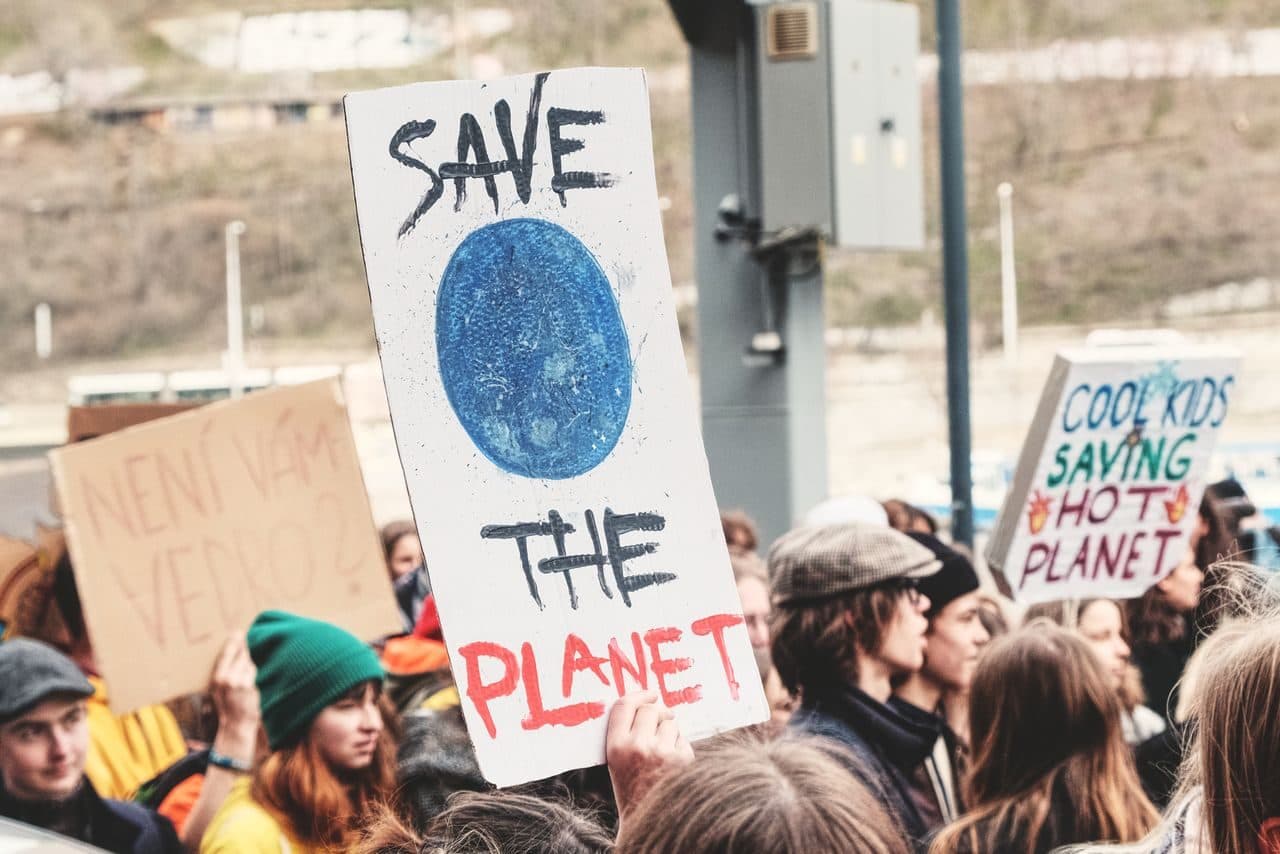
Stock photograph - Tomas Ryant / Pexels. Used to illustrate this editorial; the people shown are not connected to it.
A handmade sign in a European capital has become the default image of the climate crisis. It is a real story - but it is not the whole one, and the difference decides who gets heard.
Picture the climate crisis. Go on - actually picture it.
Most of us produce the same image: a crowd of young people, a European city square, and a sign held above the heads of the crowd. The cardboard is uneven. The lettering is handmade. It says something like SAVE THE PLANET.
We have illustrated this editorial with exactly that photograph, because it is the picture that has come to stand in for an entire planetary emergency. That is not an accident, and it is not the fault of the people holding the sign.
Look closer at it, though. There is a second sign in the frame, in Czech: Není vám vedro? - "Aren't you hot?" It is funnier and sharper than the English one beside it, and it is aimed squarely at the people it is standing among. It is also the sign that will never travel, because the only audience who gets it without a translation is already there.
One sign was written to be understood in that square. The other was written to be understood everywhere else. Guess which one you have seen before.
Why this image won
The protest photograph is, by every practical measure, an excellent piece of journalism. It is legible in a fraction of a second. It has faces, colour, motion and a slogan a reader can absorb without a caption. It fits a square crop. It works at thumbnail size on a phone.
Compare that with what climate change mostly looks like: a field that yielded less than last year. A well that has to be walked to twice as far. A house that has been rebuilt three times in a decade. Air that is a little more difficult to breathe every summer. None of this photographs well. None of it happens on a Friday afternoon at a scheduled time in a capital city with good transport links.
So the picture that travels is the protest, and the picture that stays home is the consequence.
The quiet edit this performs
Here is the part that should concern anyone who works in media.
When one image becomes shorthand for an issue, it stops being a window and starts being a filter. It sets an unspoken standard for what a climate story has to look like before an editor recognises it as one. A demonstration in Prague or Berlin or Milan reads instantly as climate. A farmer in a region no bureau covers, describing three consecutive bad harvests, reads as - what, exactly? Agriculture? Local economics? Nothing at all?
The result is a strange inversion. The people most protected from the consequences of climate change are the most visible in its coverage. The people already living inside those consequences are the hardest to see.
This is not an argument against protest, or against covering it. It is an argument against letting one photograph define the boundaries of an entire beat.
What we are choosing to do about it
VOTVS was started to cover the communities that do not generate this kind of image. That commitment gets tested first and hardest on climate, because climate is where the visual shorthand is strongest and the temptation to reach for it is greatest.
So we are putting the standard in writing:
- We report the consequence, not only the demonstration. Protests are covered as one part of a story, not as the whole of it.
- We go where the pictures are difficult. A story does not need a strong image to deserve reporting. If it is hard to photograph, that is often a sign nobody has been.
- We name what an image is. The photograph at the top of this piece is stock. It shows real people at a real demonstration who have nothing to do with our argument, and we have said so under it rather than letting you assume otherwise.
- We let people describe their own weather. Not "victims of climate change" - farmers, fishers, parents, who will tell you precisely what has changed and when, if anyone asks.
The test we would like to be held to
There is a version of climate journalism that consists entirely of covering people who are demanding that something be done. It is easier, cheaper and more shareable than the alternative.
The alternative is finding the person for whom something already happened, in a place with no press presence, and giving them the same square footage a protest gets. That is slower and it costs more. It is also the actual story.
If you only ever see the sign, and never the drought, you have been shown a movement without being shown a crisis.
We would rather show you both.